
K2 Expedition | Pakistan’s No.1 Guide
Expedition Overview
Considered as one of the most exciting mountaineering experiences available worldwide is the K2 Expedition It blends the delight of visiting the vibrant Himalayan and Karakoram regions of Skardu, Shigar, and Askoli with the exhilaration of climbing and trekking across the Baltoro Glacier.
You will be in awe of additional world-class mountains including: during the K2 Expedition:
- Broad Peak (8,044 m)
- Gasherbrum Group
- Chogolisa (7,686 m)
- Golden Throne (7,365 m)
- Trango Tower
Our guide will welcome you at Islamabad International Airport and drive you to your accommodation at Islamabad, where the adventure starts. You will have time to get well and attend an adventure briefing.
You will fly scenicly to Skardu the next day, with amazing aerial views of Nanga Parbat, K2, other Himalayan and Karakoram towers. When you get to Skardu, you could either lounge about the busy local market or rest.
Final plans for the trip ahead are developed at Skardu. Here, Trekkers and climbers often stockpile items they need. From Skardu, you will ride a jeep to Askoli, the last town before entering the isolated Karakoram Mountains. You will be camping under the stars your first night.
Starting at Askoli, the trekking phase follows Braldu Gorge to the Baltoro Glacier finally arriving at Concordia — the “Throne Room of the Mountain Gods.
The trip from Concordia proceeds to K2 Base Camp, where the climbing phase starts. Mountain guides, chefs, and support workers among other members of our knowledgeable team will guarantee your comfort and safety all during the trip. Our cooks will create wholesome meals to keep you going for the ascent.
The return trip from the climbing part will travel the same path back to Islamabad. The excursion ends with a last night in Islamabad you will be flown back to Islamabad International Airport.
Mount K2, also known as Chogori is the second-highest mountain in the world rising to 8611 meters above sea level. Located in the Karakoram Range on the border between Pakistan and China K2 is widely regarded as one of the most difficult and dangerous mountains to climb. Often called the “Savage Mountain” or “Killer Mountain” it was famously described by Reinhold Messner as the “Mountaineer’s Mountain” due to its extreme challenges. The climb is rocky up to 6,000 meters, after which it becomes a vast expanse of snow and ice. First surveyed by the British in 1856 K2 saw its first climbing attempt in 1902 and a notable expedition in 1909 led by the Duke of the Abruzzi. The first successful ascent was achieved on July 31 1954 by an Italian team led by Ardito Desio with Lino Lacedelli and Achille Compagnoni reaching the summit. The sheer vertical nature of the climb the technical difficulty, and harsh weather make K2 a true test of endurance and skill.
Trek Highlights
Stunning views of K2 and surrounding peaks at 4,700m
Baltoro Glacier :Trek across one of the world’s largest glaciers
K2 Base Camp :Get close to the legendary mountain
Explore traditional Balti life and heritage
Summit attempt for climbers (on climbing expeditions)
Views of Broad Peak, Gasherbrum I & II, Trango Towers
Expedition-Style Trek Real high-altitude adventure experience
Learn mountaineering and acclimatization techniques
Interact with locals and experience their lifestyle
Quality tents and delicious traditional meals
Trek with fellow adventurers from around the world.
Visit the green and vibrant capital city of Islamabad.
Spectacular views of K2 and Nanga Parbat during the scenic flight to Skardu.
Included/Excluded
| INCLUDED |
|
|||||||||||||||||||||||
| NOT INCLUDED |
|
Additional information
| location | Islamabad, PK |
|---|---|
| duration | 21 Days |
| tour type | Daily Tour |
| group size | 1 Person |
Day 1: Arrival in Islamabad & Transfer to the Hotel
You have arrived in Pakistan! The majority of international flights arrive at Islamabad International Airport in the morning as they depart. Your K2 Adventure Guide will first meet and greet you at the airport and then they will transfer you to the hotel upon your arrival. You are free to take the rest of the day off to recuperate after your journey. The K2 Expedition will be the subject of a group briefing that will take place later in the day once everyone has arrived. Depending on the amount of time that is available there is also the possibility of going sightseeing in Islamabad which is a city that was constructed specifically for the goal of serving as the new capital of Pakistan in 1961.
Day 2: Fly from Islamabad to Skardu (2,228m)
The Karakoram Highway (KKH) will be our route to Chilas, which is 461 kilometres away and would take us between eight and nine hours to get. Immediately following breakfast you will be sent to Islamabad Airport where you will embark on a breathtaking flight via the mountains to Skardu, the capital of Baltistan, provided that the weather permits. During the trip, which lasts for forty-five minutes, passengers are treated to stunning views of the Himalayas and Karakoram mountains, including the awe-inspiring Nanga Parbat (8,126m). You might even be able to catch a glimpse of K2 and Broadpeak if the weather is clear. Skardu serves as the entry point to a number of famous mountains including the K2 Expedition and the K2 Base Camp Trek. When you have finished checking in at the hotel, you can spend the remainder of the day touring the local bazaars, ancient forts, gorgeous lakes, or going to the Manthal Lord Buddha Rock, which dates back to the eighth century.
Day 3: Rest day in Skardu
The ruins of Kharpocho Fort, which was constructed in the early 1700s and overlooks Skardu Town, can be visited in the morning. The fort provides breathtaking views of the Indus River. Photos of the sunrise or sunset can be taken from this spot by those who are interested in photography (optional arrangements are available). Proceed to Organic Village, which is well-known for the absence of pesticides in its crops. The afternoon is free for exploration in Skardu, with jeep drives to Satpara Lake and visits to local bazaars being available as optional activities.
Day 4: Drive from Skardu to Askole (2,600m)
Early in the Morning Drive to Askoli Village is the final populated settlement before entering the Karakoram wilderness. It may be reached by driving along the huge Indus, Shigar, and Braldu Rivers. Spend your first night camping in Askoli, surrounded by apricot trees, potato fields, and the raging Braldu River. Spend your first night under the stars.
ACCOMMODATION: Camping
MEALS: Breakfast, Lunch, Dinner
Day 5: Trek from Askole to Jhola (3,185m)
To get started on your journey, collaborate with the porters to organise your supplies and equipment. As you make your way to Concordia, proceed through the fields and lanes of Askoli, the final human habitation on the way. In order to reach Korofon, a green riverbank campsite, you will need to traverse the snout of the Biafo Glacier. Once you arrive, you can either relax or go on an acclimatisation stroll. Trekking should continue in a side valley, and a footbridge should be used to cross a river that is moving quickly. Obtain the campground at Bardumal, which offers a view of Bakhor Das, which is 5,809 meters high, as well as the needle-shaped spires of Paiju Peak in the distance.
ACCOMMODATION: Camping
MEALS: Breakfast, Lunch, Dinner
Day 6: Trek from Jhola to Paiyu (3,383m)
Today’s walk will take you along the riverbank, and then it will lead you to higher terrain, where you will have views of Paiju Peak, which is 6,611 meters in elevation. After traversing glacial streams, you will arrive to Paiju, an oasis camp that offers breathtaking views of the Baltoro Glacier, Trango Towers, and other famous peaks.
ACCOMMODATION: Camping
MEALS: Breakfast, Lunch, Dinner
Day 7: Rest day in Paiyu
During the day, you should become accustomed to Paiyu. It is important to allow your body to adjust to the high altitude while you are exploring the neighbouring alpine meadows and taking in the vistas of snow-capped peaks.
ACCOMMODATION: Camping
MEALS: Breakfast, Lunch, Dinner
Day 8: Trek from Paiyu to Urdukas (4,130m)
You will camp on grassy slopes with panoramic views of Trango Towers, Cathedral Peak, and Lobsang Spires when you reach Urdukas, which is reached after a day that is somewhat shorter but more difficult.
ACCOMMODATION: Camping
MEALS: Breakfast, Lunch, Dinner
Day 9: Trek from Urdukas to Goro II (4,250m)
Leaving Urdukas behind, you follow the moraine edge eastwards until it is possible to climb up onto the broad back of the glacier. The trail on the Baltoro goes past the Yermanandu glacier, which flows from Masherbrum, and there are views of Muztagh (7,270m), Masherbrum (7,800m) and Gasherbrum IV at the head of the Baltoro and Concordia. You are quite high now and camping on one of the largest pieces of ice outside the polar regions, so we will make sure to wrap up warmly for the cooler nights ahead. The campsite is on the glacier where ledges have been levelled out for the tents.
ACCOMMODATION: Camping
MEALS: Breakfast, Lunch, Dinner
Day 10: from Goro II to Concordia (4,690m)
Today, we will trek to Concordia, one of the most beautiful and dramatic places in the world. Concordia is where several mighty glaciers meet and where many of the highest mountains on Earth stand close together.As we walk along the huge Baltoro Glacier, we pass impressive peaks like Mustagh Tower (7,284m). In front of us the striking Gasherbrum IV (7,925m) stands tall, and if the weather is clear we may also see Gasherbrum II (8,035m) peeking from behind.Later the wide and beautiful Broad Peak (8,051m) comes into view rising above Marble Peak and Crystal Peak on our left side.
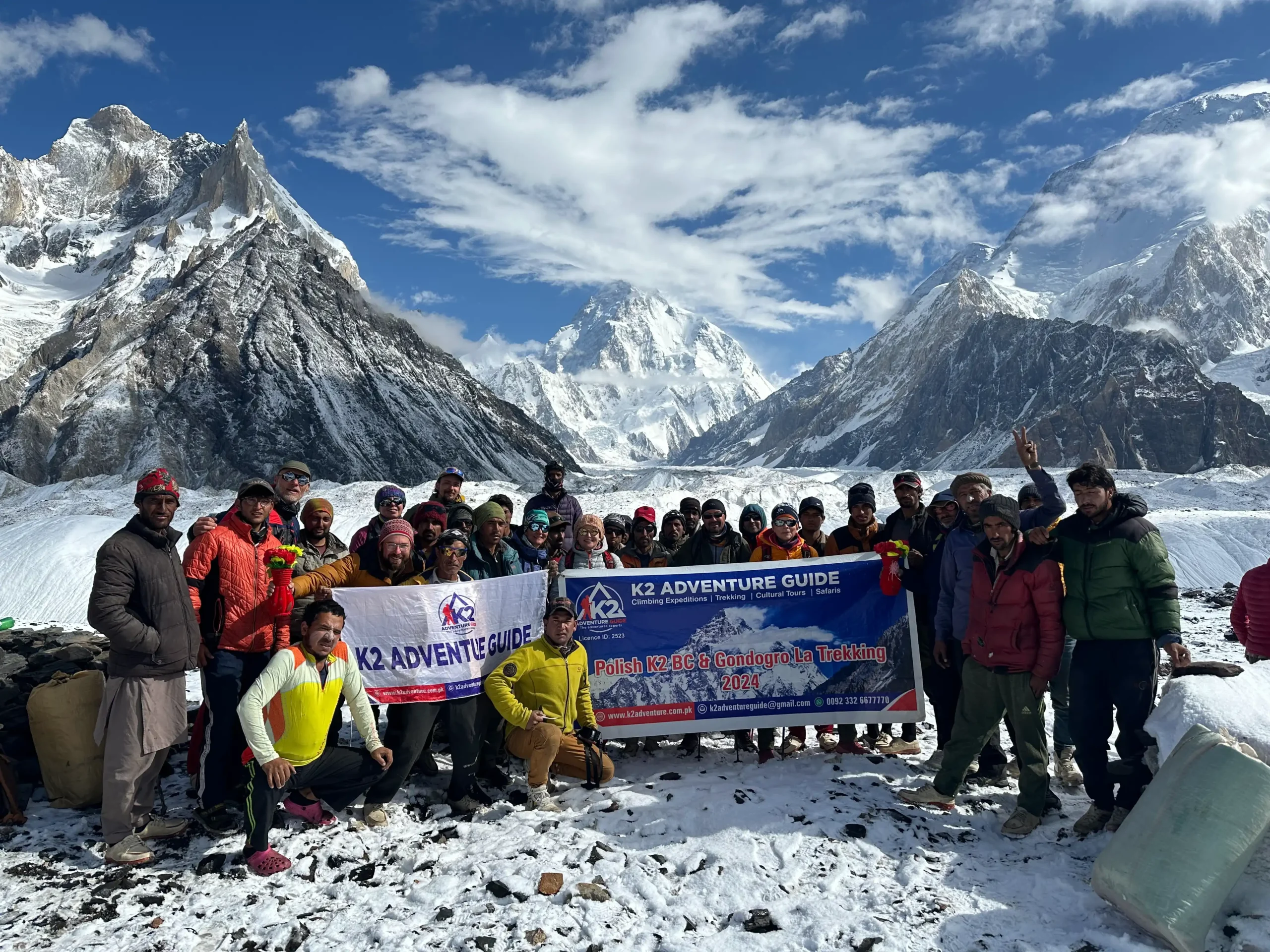
Then comes a magical moment just as we reach Concordia the mighty K2 suddenly appears in full view. This is the second-highest mountain in the world (8611m) and its steep face rising almost 4000 meters from the valley floor is a sight you will never forget.Concordia is a wide open area where glaciers from K2 the Gasherbrums and Chogolisa meet. It is one of the most stunning places on Earth. From here, you can see four 8,000-meter peaks and ten of the world’s thirty highest mountains all around you.
peaks including Gasherbrum IV, Mitre Peak, Chogolisa, Crystal Peak, Marble Peak, Baltoro Kangri, Broad Peak and K2.
ACCOMMODATION: Camping
MEALS: Breakfast, Lunch, Dinner
Day 11 - 12: Trek from Concordia (4,690m) to K2 Basecamp (5,150m)
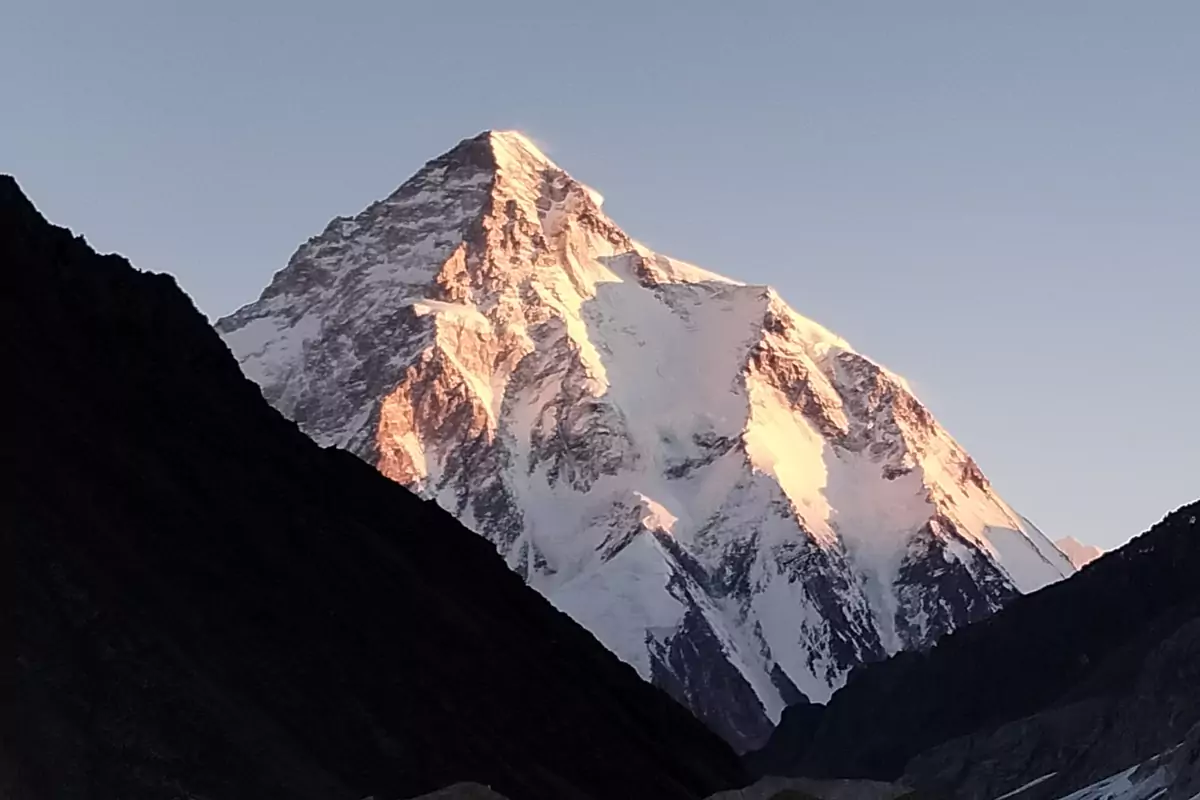
Wake up early to witness an unforgettable sunrise lighting up K2 and the surrounding Karakoram giants a magical way to start the day. After breakfast at Concordia we begin our walk towards Broad Peak Base Camp.The trail leads us across a mix of ice fins rocky ridges,and glacial terrain as we make our way onto the Godwin-Austen Glacier. Walking along its central ridge we eventually reach the base camp of Broad Peak.This camp is set near the foot of the mountain’s climbing route and offers one of the finest views of K2 majestic towering and unforgettable. Surrounded by some of the world’s highest peaks this is truly a breathtaking location deep in the heart of the Karakoram.Take a moment to relax, take photos, and soak in the peaceful but powerful beauty of this high mountain world.
ACCOMMODATION: Camping
MEALS: Breakfast, Lunch, Dinner
Day 13 - 35: Rotation: {Basecamp – Rotation (Camp I, Camp II and Camp III-iv) – Basecamp}
To safely climb Broad Peak we follow an acclimatization rotation. This means we go up and down the mountain in stages before the final summit push.
From Base Camp we climb to Camp I then return.
Next we go to Camp I continue to Camp II and descend again.
On the third rotation we may reach Camp III then return to Base Camp to rest and recover.
This rotation system helps the body adjust to high altitude and improves chances of a successful and safe summit attempt.
Day 36 - 43: Climbing Period: {Base Camp – Broad Peak Summit (8,051m) – Base Camp}
After completing the acclimatization rotations and resting at Base Camp we begin the final summit push.From Base Camp we move up through Camp I, Camp II and Camp III depending on conditions. The summit attempt is usually launched from Camp III during the night or early morning hours to reach the top of Broad Peak (8051m) by sunrise or early day.After celebrating the summit we carefully descend back down through the camps and return to Base Camp for a well earned rest.This is the most challenging and rewarding part of the expedition reaching the summit of an 8000-meter peak!
Day 44 - 45: Cleaning Up Basecamp: Preparation for descending back
With the summit behind us it’s time to give back to the mountain. Before leaving we clean up Base Camp collecting all waste packing gear and ensuring nothing is left behind. This is part of our commitment to Leave No Trace and respect the natural beauty of the Karakoram.Once everything is packed and the camp is cleared we begin our descent back down the Baltoro Glacier carrying unforgettable memories of Broad Peak and the mighty K2 region….
Day 46: Trek from Basecamp to Goro II
Leaving Urdukas behind you follow the moraine edge eastwards until it is possible to climb up onto the broad back of the glacier. The trail on the Baltoro goes past the Yermanandu glacier which flows from Masherbrum and there are views of Muztagh (7270m) Masherbrum (7800m) and Gasherbrum IV at the head of the Baltoro and Concordia. You are quite high now and camping on one of the largest pieces of ice outside the polar regions so we will make sure to wrap up warmly for the cooler nights ahead. The campsite is on the glacier where ledges have been levelled out for the tents.
Day 47: Trek from Goro II to Khuburtze
On this day, the participants will go to the Urdukas campground and then follow the same track down the glacier to Goro I. They will have spectacular views of Trango Towers before arriving in Khurburtse. Even though the participants will be following the same trail, the sights on the way back will be very different.
Day 48: Trek from Khuburtze to Paiju
On this day of the K2 base camp trek, participants will travel down the glacier via Liligo, which will be the final region where they will alter their track from the glacier to somewhat firm ground. After a break, the participants will be able to relax among the trees and enjoy their time at the Paiju camp site
Day 49: Trek from paiyu to Askole
Today is the last day on foot. We return to Askole village, where our jeep is waiting. There is a sense of success in the air, and the trekking group frequently celebrates the completion of the expedition with a special lunch or a group portrait. Porters and staff are tipped and praised here, as many return to their home towns from Askole.
Day 50: Drive from Askole to Skardu
The rocky jeep trip back to Skardu seems like returning to civilization. You will pass through the amazing gorges once more, taking in the beauty of the Braldu and Shigar Valleys from a new perspective. After weeks in the wilderness, a hot shower and a comfy bed will feel luxury when you arrive in Skardu. You will have the evening free to wander about town, browse for handicrafts, or eat at a local Balti restaurant
Day 51: Leisure day in Skardu (De-briefing at Ministry)
After returning from the mountains enjoy a relaxing day in Skardu. This is a time to rest reflect and refresh after the expedition.We will also attend the official de-briefing at the Ministry of Tourism where we report the success of the climb and share any important information.The rest of the day is yours to explore the town, enjoy local food or simply relax while surrounded by the peaceful beauty of Skardu
Day 52: Fly from Skardu to Islamabad & transfer to the Hotel
We take the beautiful morning flight back to Islamabad, passing over the huge mountains of Karakoram, Himalaya, and Hindu Kush. When you arrive, you will be transported to your hotel. The afternoon is free for rest, sightseeing, and souvenir shopping. An optional farewell supper at a traditional restaurant allows you to experience local food and reminisce the highlights of your adventure with fellow trekkers.
Note: In case of flight cancellation, overland travel via the Karakoram Highway will be arranged (2 days total).
Day 53: Transfer to the International Airport for final departure
It’s the last day in Pakistan after a wonderful trip. We will drop you off at the airport so you may fly back home with many happy memories.
We understand our K2 expedition’s pricing may seem unusually low compared to other operators. This is possible because it is a Joint Expedition involving 12 experienced outfitters.
By pooling resources, logistics, and expertise, we significantly reduce overhead costs while maintaining the highest standards of safety, quality, and service.
Our goal is not to maximize profits but to make K2 accessible to more climbers, promote adventure tourism in Pakistan, and support local communities. This collaborative approach ensures operational efficiency and affordability without compromising on the quality of your experience.
We are dedicated to providing a safe, memorable, and rewarding climb, working closely with our local teams and Sherpa’s to ensure the success of this iconic expedition.
The weather on K2 is one of the most critical factors for a successful ascent, and climbers should be prepared for extreme conditions. As one of the most challenging mountains in the world, K2 is notorious for its unpredictable and harsh weather. Here’s what you can expect and how we manage these conditions on our expeditions:
The best window for attempting a summit of K2 is typically during the summer months, between late June and mid-August. This is when the weather is slightly more stable, and the chances of encountering severe storms or extreme cold are lower. However, even during this period, K2 can experience rapid weather changes, so climbers need to be prepared for all conditions
On K2, climbers can expect extreme cold, high winds, and the risk of storms at any time. Temperatures at Base Camp can range from -10°C to -30°C (14°F to -22°F), while at higher altitudes, especially at Camp 2 and above, temperatures can plummet to -40°C (-40°F) or lower, particularly during the night. Wind speeds can reach 100-120 km/h (62-75 mph) or more, adding to the chill factor and significantly increasing the danger.
Extreme Weather Conditions:
Weather on K2 is highly unpredictable. While the summer window offers a higher likelihood of favorable conditions, snowstorms, avalanches, and sudden shifts in wind direction are common. These can cause delays in summit pushes or force climbers to descend to lower camps for safety. The weather on K2 can be far harsher than on other 8,000-meter peaks, with some of the highest winds recorded on any mountain.
Managing the Weather Risks:
Our expedition team works closely with experienced local guides and Sherpa’s who are highly skilled in reading the weather patterns of K2. Before the climb, we provide all climbers with in depth training on how to recognize dangerous weather signs, the importance of respecting weather windows, and what to do in case of a storm. We also monitor weather forecasts from multiple sources, including satellite data and reports from local weather stations, to stay updated on changing conditions.
Acclimatization and Weather Delays:
Weather can have a significant impact on the acclimatization process. If high winds or storms prevent safe progress, we may delay our push to higher camps until conditions improve. The goal is to balance the need for acclimatization with safety. If the weather is particularly adverse, we may adjust the expedition schedule to allow for more rest days at lower camps. We also work with climbers to ensure they are flexible and prepared for potential weather related delays.
Storms and High Winds:
One of the most common weather-related risks on K2 is high winds. The upper reaches of the mountain can experience gale-force winds which can make climbing extremely difficult and dangerous. We plan summit pushes around anticipated weather windows—days when conditions are expected to be relatively stable, with clear skies and manageable winds. This is crucial for success, as attempting the summit in high winds or poor visibility is extremely risky.
Impact on the Climbing Route:
Severe weather, particularly avalanches, can affect the climbing route and may require rerouting or delays. We have experienced sherpas on the ground who are trained to assess and navigate any changes to the route caused by weather-related hazards. Avalanche risk is higher on K2, especially after heavy snowfall or during warm weather when snow melts quickly and can become unstable. Our team is always vigilant and prepared to make changes to the route or schedule if necessary.
Backup Plans and Flexibility:
We have contingency plans in place to ensure that climbers are always safe, even if weather conditions worsen unexpectedly. If a summit attempt is not possible due to weather, our priority is always the safety of the team. We wi l adjust our schedule, retreat to lower camps, or wait for better weather conditions. Our team’s flexibility and experience are key to managing K2’s unpredictable climate.
Necessary Gear for Extreme Conditions:
Climbers must come fuly prepared for the cold and extreme conditions on K2. We provide detailed gear lists that include high-altitude clothing, including a down suit for summit day, double boots, and insulated gloves, along with necessary technical climbing gear. The combination of the harsh weather and the altitude means that staying warm and dry is critical to your success and safety on the mountain.
Sherpas and Local Guides:
Our experienced Sherpas, who are experts in the local weather conditions and terrain, will lead the group through the entire expedition. They are adept at reading the mountain and understanding weather patterns that climbers may not be familiar with. Their guidance ensures that we make smart decisions about when to ascend, when to rest, and when to retreat to lower camps for safety.
To join our Joint K2 Expedition 2025, climbers should ideally have substantial experience in high-altitude mountaineering and technical climbing. While we don’t have very strict requirements, we expect participants to be familiar with the demands of climbing at altitudes above 7,000 meters and have at least one 8,000-meter peak experience. Here’s a general breakdown of the experience we recommend.
At least one 8,000-meter peak:
Ideally, you should have summited one 8,000-meter peak or at least attempted one. This will give you experience with the extreme conditions, physical challenges, and mental toughness required on mountains like K2.
Experience on multiple 7,000-meter peaks:
In addition to your 8,000-meter experience, multiple 7,000-meter climbs help demonstrate your capability to handle high-altitude conditions, technical terrain, and exposure to harsh weather.
Technical climbing skills:
You should have experience with ice climbing, mixed terrain, and fixed ropes. Climbing K2 requires proficiency in these areas, as you’ll encounter steep ice and rock sections.
Acclimatization and altitude management:
Experience with high-altitude expeditions and the ability to manage acclimatization are essential. You should be familiar with the symptoms of altitude sickness (AMS, HAPE, HACE) and know how to respond to these conditions.
Teamwork and decision-making:
K2 is a challenging environment that requires collaboration and good decision-making. Experience in high-altitude expeditions with a team is highly valuable, as it will help you navigate the social and logistical dynamics of a large-scale climb.
Mental and physical preparation:
Mental fortitude and physical fitness are essential. You must be comfortable with the long durations, extreme weather, and potential setbacks typical of high-altitude climbs.
Yes, you can still join our Joint K2 Expedition 2025 even if you have summited only one 8,000-meter peak. Having experience with one 8,000-meter climb is certainly a positive factor, and many climbers with one successful 8,000-meter summit have gone on to attempt K2.
However, we do recommend that climbers with just one 8,000-meter experience have also climbed several 7,000-meter peaks and have substantial experience in technical climbing, altitude management, and working in a team environment. If your previous 8,000-meter climb was demanding and you’ve had the opportunity to gain significant experience at those altitudes, then you’re likely well-prepared for the challenges K2 presents.
During the selection process, we will take a holistic approach, looking not just at the number of climbs, but also the specific conditions, technical difficulty, and success rate of your past expeditions. If you feel confident in your abilities, are physically and mentally prepared, and have the necessary skills for high-altitude and technical climbing, then we encourage you to apply.
Our goal is to ensure that each participant is prepared for the unique challenges of K2, but we also believe in offering opportunities to climbers who have the right mindset, preparation, and experience, even if they have not climbed as many 8,000-meter peaks as others.
There is no strict minimum age limit for the expedition. However, climbers should have sufficient physical fitness, endurance, and experience to safely tackle a high-altitude climb like K2. We generally recommend climbers be at least 18 years old to ensure physical maturity, but more importantly, that participants are in excellent physical condition, regardless of their age.
There is no fixed maximum age limit either. We have had climbers in their 50s and 60s successfully summit K2, provided they are in excellent health and physical condition. The primary consideration is physical fitness—climbers need to be physically prepared for the extreme conditions of K2, including the physical demands of altitude, technical climbing, and long days of trekking.
Absolutely! Age is not a barrier as long as you are in great shape. Many climbers over 50 have successfully completed expeditions to high-altitude peaks, including K2. We place the most importance on your physical fitness, stamina, and health. If you have a strong fitness regimen, a history of successful high-altitude climbs, and a healthy lifestyle, then you may very well be a great candidate for the expedition.
We assess fitness based on overall health, endurance, strength, and acclimatization ability.
Some key indicators include:
- Cardiovascular health: You should be able to handle prolonged physical exertion, such as long ascents at high altitudes.
- Strength: Strong core, legs, and upper body to manage technical climbs and carry gear in challenging terrain.
- Endurance: The ability to hike for hours on steep terrain, often with heavy packs.
- Recovery ability: How quickly your body recovers after strenuous activity, including managing the effects of altitude.
We recommend that climbers undergo a thorough medical evaluation and, if necessary, a fitness assessment from a coach or trainer with experience in mountaineering.
Training for a climb like K2 is essential at any age, but as you get older, it becomes even more important to prepare your body properly. Focus on:
- Cardio fitness: Long hikes, running, cycling, or swimming to improve cardiovascular endurance.
- Strength training: Focus on legs (for hiking and climbing), core (for stability), and upper body (for handling technical climbs and carrying gear).
- Endurance and stamina: Practice climbing on steep terrain or using weighted packs to simulate the conditions you’ll face.
- Flexibility and mobility: Stretching, yoga, or mobility exercises to prevent injuries.
A balanced training plan that includes aerobic, strength, and technical exercises will significantly improve your chances of success.
Climbers in their late 40s or early 50s who are physically fit and prepared for the technical challenges of K2 are often successful on the mountain. While experience is important, physical preparation and mental readiness are the most crucial factors. If you have already completed climbs in the 7,000-meter range or have experience with high-altitude trekking, then with proper training, you could be well-prepared for the challenges of K2.
Acclimatization is critical for everyone, but older climbers may experience slower acclimatization compared to younger climbers due to factors like reduced lung capacity or recovery times. This is why it’s even more important for older climbers to focus on physical conditioning well in advance of the expedition. With proper preparation, nutrition, hydration, and adherence to acclimatization schedules, most climbers, regardless of age, can perform well at high altitudes.
Yes, age is not a limiting factor if climbers are in excellent shape. The physical challenges on K2 require endurance, strength, and resilience. If you are in good health, have no underlying medical conditions, and follow a well-structured training regimen, there’s no reason you can’t successfully summit K2. Some of the most experienced mountaineers in their 50s, 60s, and even beyond have achieved great success on high-altitude climbs, demonstrating that age should not be a limiting factor for those who are fit and well-prepared.
Older climbers should undergo a thorough medical check-up to assess their cardiovascular health, lung function, and overall fitness for high-altitude environments. We recommend a full checkup to ensure there are no underlying conditions that could be exacerbated by altitude or the physical demands of the climb. Additionally, older climbers should have a detailed discussion with their doctor regarding the potential impact of altitude on their health and any precautions they should take during the expedition.
Tipping is a common practice in Pakistan, and while there is no fixed rate, it is customary to tip porters and staff who assist during the expedition. Tips are not included in the expedition price, and porters often expect a tip as a token of appreciation. A general guideline is to provide USD 300 to USD 500 as tips for porters. Additionally, for altitude porters, there is a summit bonus of USD 1500, which is also not included in the package price.
For many years, foreign companies have dominated the expedition business in Pakistan. However, the local mountaineering community has now come together to reclaim their space in this industry. This collaboration includes all major stakeholders from Pakistan’s mountaineering sector, working collectively to manage the K2 joint expedition. This joint effort ensures a seamless and authentic experience for all participants.
Yes, a few equipment (e.g. crampons, mountaineering boots, harness, climbing helmet etc.) can be rented and purchased in Skardu town but it is not guaranteed that you will find the right size or the right price.
Normally it costs between 45 to 65 euros to rent the above-mentioned equipment. The few mountain equipment stores in Skardu wait all year long to sell/rent these equipment at the best price possible. These equipment are used/second-hand equipment available in the market and not always reliable. The rents for these equipment are not fixed. Our guide normally takes our guests for shopping/renting
You will need a special visa called the trekking and mountaineering visa. This visa typically takes thirty to forty days for approval and should be applied for at least two months before your planned arrival. We will provide all the necessary documents and assistance to help you with the visa application process.
This trek is remote and challenging. It’s highly recommended to go with a trusted guide or tour company.
The safety of Pakistan for foreigners depends largely on the region. With a population of over 240 million, the country has diverse provinces with varying security situations. Some areas, such as former FATA and Balochistan, remain unsafe and are excluded from our itineraries. These regions are not representative of Pakistan as a whole, particularly tourist areas.
Gilgit-Baltistan, home to the Karakorams, Himalayas, and Hindukush, is not only stunning but also one of the safest regions. The locals, known for their hospitality and reliance on tourism, welcome visitors warmly. Islamabad, the country’s capital, is also considered one of the safest cities, alongside major urban centers like Lahore and Karachi. Pakistan ranks 146th on the Global Peace Index but continues to improve its security infrastructure. Tourism has increased by 317% since 2014, thanks to government initiatives and international promotion.
We prioritize guest safety and advise travelers to check their home country’s travel advisories. Trips are only conducted when we are confident in the safety of all destinations.

Tour Reviews
There are no reviews yet.
Leave a Review