

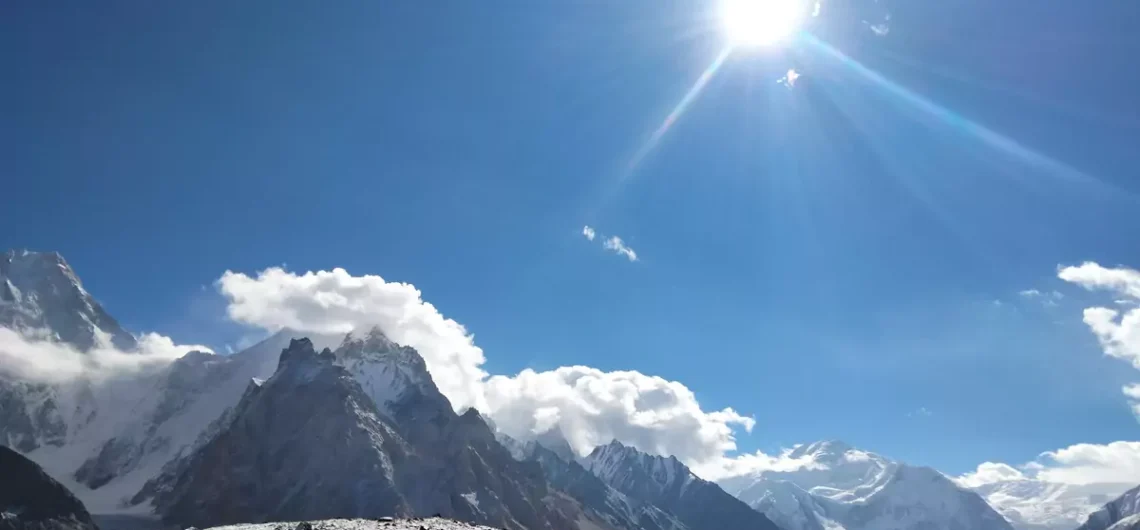
At elevations above 16,000 feet, the world changes dramatically. The air is thin, making every breath a challenge. Snow and ice dominate the landscape, stretching across ridges and valleys. Towering peaks surround the horizon, their sharp summits rising higher than nearly any place on Earth.
And then, right in front of you, rises K2. A jagged stone pyramid, fierce and untamed. The mountain with the deadliest reputation in the climbing world.
But here’s the twist most people don’t know: the K2 mountain location isn’t where you might expect.
Where Is K2 Located? The Surprising Answer
When someone asks, “Where is K2 mountain located?” most people guess Nepal. Like Mount Everest. Or somewhere in the Himalayas. They’re wrong.
K2 sits at coordinates 35°52′57″N 76°30′48″E in Pakistan’s Gilgit-Baltistan region. It’s just 4 kilometres south of the Pakistan-China border.
That’s right , K2 location is in the Karakoram Range, not the Himalayas. The summit sits in Pakistan. But you can almost touch China from the top.
This isn’t just geography trivia. The K2 mountain location makes it one of the hardest peaks to reach on the planet. No airport sits nearby. No roads lead to base camp. No Sherpa villages dot the landscape like those around Everest.
Just you, the glaciers, and 28,251 feet of deadly mountain.
Administrative Location Details
| Attribute | Detail |
| District | Shigar (est. 2015; previously part of Skardu District) |
| Province/Region | Gilgit-Baltistan, administered by Pakistan |
| Nearest major city | Skardu, ~160 km southeast (by road), gateway to the Karakoram |
| Nearest village | Askole, last road-accessible settlement (start of treks |
The Karakoram Range: K2’s Wild Home
Understanding the K2 location means understanding the Karakoram Range. And why it’s different from everywhere else on Earth.
The Karakoram spans Pakistan, China, and India. But K2 sits in its heart in the Baltoro Muztagh area. This isn’t some gentle mountain chain. The Karakoram is younger, sharper, and more violent than the Himalayas. Glaciers here don’t just flow. They surge forward in sudden bursts. They reshape valleys overnight.
Here’s what makes the location of K2 so unique:
- It rises 3,000 meters straight up from the valley floors
- No gentle hills ease the approach (unlike Everest)
- Weather systems crash together here from three directions
- The rock is granite and gneiss—harder and more broken than Himalayan stone
This violent geology created the mountain that climbers call “Savage Mountain.” But it also created some of the most beautiful mountain scenery on Earth.
Getting to K2: Your Journey to the Edge of the World
Your journey to the K2 location starts in Skardu. This mountain town sits 160 kilometres southeast of the peak. This is your last taste of normal life before you enter one of Earth’s most remote places.
The Route That Changes Everything
From Skardu, you travel by jeep on rough mountain roads to Askole. This is the last village before K2. Askole sits at the mouth of the Baltoro Glacier. Here, the modern world ends, and the ancient world of ice begins.
The classic route looks like this:
- Skardu → Regional hub, permits, supplies
- Shigar → Historic valley, last major town
- Askole → Final village, trek starts here
- Jhola → First camping spot on the glacier
- Paiju → Rest day, get used to the altitude
- Urdukas → Amazing views begin
- Goro II → Gateway to the giants
- Concordia → “Throne Room of the Mountain Gods”
- K2 Base Camp → Your destination
This isn’t a casual weekend hike. The trek to K2 base camp covers over 100 kilometres across moving glaciers. You’ll cross rivers and walk over terrain that changes daily as ice shifts and melts.
But here’s why the journey matters: Every step teaches you why the K2 location makes this mountain so special. You’re not just walking to a mountain. You’re entering a world that exists nowhere else on Earth.
Neighboring Peaks (within ~30 km)
| Peak | Elevation (m) | Distance from K2 | Climbing Significance |
| Broad Peak | 8051 | 8.8 km | 12th highest in the world |
| Gasherbrum I | 8,080 | 16 -20 km | 11th highest |
| Gasherbrum II | 8,035 | 17-19 km | 13th highest |
| Masherbrum (K1) | 7,821 | 30 km | 22nd highest |
| Chogolisa | 7,665 | Appox- 30 km | 36th highest |
| Muztagh Tower | 7,273 | 15 km | |
| Trango Towers | 6,286 |
Concordia: Where Giants Gather
At the heart of the K2 location sits Concordia. It’s where glaciers meet. Climbers call it the “Throne Room of the Mountain Gods.”
Standing here, 12 kilometres from K2, you’ll see something that exists nowhere else on our planet: four peaks over 8,000 meters all visible at once.
- K2 (8,611m) – The pyramid that rules everything
- Broad Peak (8,047m) – 8.8 kilometres away
- Gasherbrum I (8,080m) – The “Hidden Peak”
- Gasherbrum II (8,035m) – The most climbed giant
This cluster of massive peaks exists because of K2’s location in the Baltoro Muztagh. The same forces that created K2 also pushed up its neighbours. This created an arena of stone and ice.
Pro tip: Many trekkers spend extra days at Concordia just soaking in views that no photo can capture. It’s worth every minute.
Climate and Weather: Why the K2 Location Creates Deadly Conditions
The K2 mountain location doesn’t just make it remote. It creates some of the most dangerous mountain weather on Earth.
The Perfect Storm Zone
Three major weather systems crash together at K2:
- Monsoons from the south (rare but deadly)
- Westerlies from Europe and Central Asia
- Continental systems from Tibet
This creates weather that changes without warning. Clear morning skies can turn into killer storms in hours. Temperatures at K2 base camp range from 10-20°C in summer days to -10°C at night. At the summit, expect -15°C to -20°C on good days. Winter temperatures drop to -40°C or lower.
Wind is the real killer. Above 7,000 meters, the K2 location puts climbers in jet-stream winds over 200 kilometres per hour. These aren’t just uncomfortable. They’re fatal.
Best Time to Attempt K2
The location of K2 creates a tiny climbing window. Most expeditions try to reach the summit between June and August. This is when:
- Monsoons haven’t reached the Karakoram yet
- Western winds are somewhat calm
- Temperatures barely reach survivable levels
Even then, only 40% of expeditions succeed. The weather at the K2 location is that harsh.
Wildlife Around K2
Despite its harsh reputation, the K2 location supports amazing wildlife across different height zones.
Lower Valleys (Below 3,000m)
Here you find orchards, river plants, and the last signs of human life.
Alpine Zone (3,000-4,500m)
Summer grazing areas with juniper, birch, and wild rose. This is where you might see:
- Himalayan brown bears
- Markhor (Pakistan’s national animal)
- Blue sheep
Glacial Zone (4,500-6,000m)
Few plants, extreme temperature swings, and tough animals, including:
- Snow leopards (the ultimate high-altitude hunter)
- Ibex with their amazing cliff-climbing skills
- Tibetan wolves
Ice Zone (Above 6,000m)
Permanent snow and ice. Only the toughest lichens and mosses live here. This is K2’s world—a place where only the hardiest life survives.
The Central Karakoram National Park protects this entire system. It recognises that the K2 location represents one of Earth’s last untouched wild areas.
K2’s Location in Pakistan: The Details
Understanding where K2 is located helps with planning your journey:
Country: PakistanProvince: Gilgit-Baltistan
District: ShigarNational Park: Central Karakoram National ParkPermits Required: Yes, through Pakistan Tourism
Border Location: The K2 summit sits just 4 kilometres from China’s Xinjiang province. But all climbing routes start from Pakistani territory.
This location makes K2 easier to reach than if it were entirely in China. China makes mountaineering permits very hard to get.
K2 vs. Everest: Why Location Matters
Everyone knows Everest. But the K2 location creates a completely different mountain experience. Many say it’s better.
Everest advantages:
- Built-up infrastructure
- Sherpa support system
- Multiple route choices
- Helicopter rescue possible
K2 advantages:
- True wilderness experience
- No crowds (40 people vs. 600+ on Everest each year)
- Technical climbing challenges
- Unspoiled natural environment
K2’s location in Pakistan’s remote north means you experience mountains like early explorers did with minimal outside help and maximum self-reliance.
Planning Your K2 Adventure: What You Need to Know
The location of K2 demands serious preparation. This isn’t a mountain you approach casually.
Physical Requirements
- Previous high-altitude experience above 6,000 meters
- Technical rock and ice climbing skills
- Extreme weather survival training
- Minimum 12 months of specific training
Time Requirements
- Base camp trek: 8-12 days
- Getting used to altitude: 4-6 weeks
- Summit attempt window: 3-5 days
- Total expedition: 60-75 days
Cost Level
K2 expeditions cost $35,000 to $100,000+ depending on:
- Guide service level
- Group size
- Equipment provided
- Support included
Ready to take the next step? Our expedition experts can help you decide if the K2 location and challenges match your experience level and goals.
Cultural Side of K2 Location
K2’s location places it at the heart of Balti culture in northern Pakistan. The Balti people have lived in the shadows of these giants for centuries. They developed unique traditions adapted to extreme mountain life.
Local names for K2:
- Chogori (Balti) – “King of Mountains”
- Ketu (Local variation)
- Mount Godwin-Austen (Old British name)
The name “K2” comes from an 1856 survey. It was the second peak measured in the Karakoram Range. Unlike Everest (named for a British surveyor), K2 kept its survey name because no local name was recorded at first.
This shows something deep about the K2 location: it exists in a place so remote that even its name speaks to human limits in understanding its majesty.
Your Next Step: Experience K2 Location Yourself
The K2 mountain location represents one of the last true wilderness adventures on Earth. Whether you dream of reaching base camp or planning a summit attempt, the journey starts with one decision.
Ready to explore the K2 location?
Our mountain specialists have guided hundreds of adventurers to K2 base camp and beyond. We understand the unique challenges of the K2 location. We can help you plan an expedition that matches your experience level and goals.
Don’t wait. Climate change is changing the Karakoram fast. Glacier routes that exist today may be gone in five years. The window for experiencing the K2 location in its current pristine state is closing.
Contact our expedition team today to discuss your K2 adventure. Whether you’re planning your first high-altitude trek or preparing for a summit attempt, we’ll help you turn your K2 location dreams into reality.
The Savage Mountain is calling. Will you answer?
Comments